
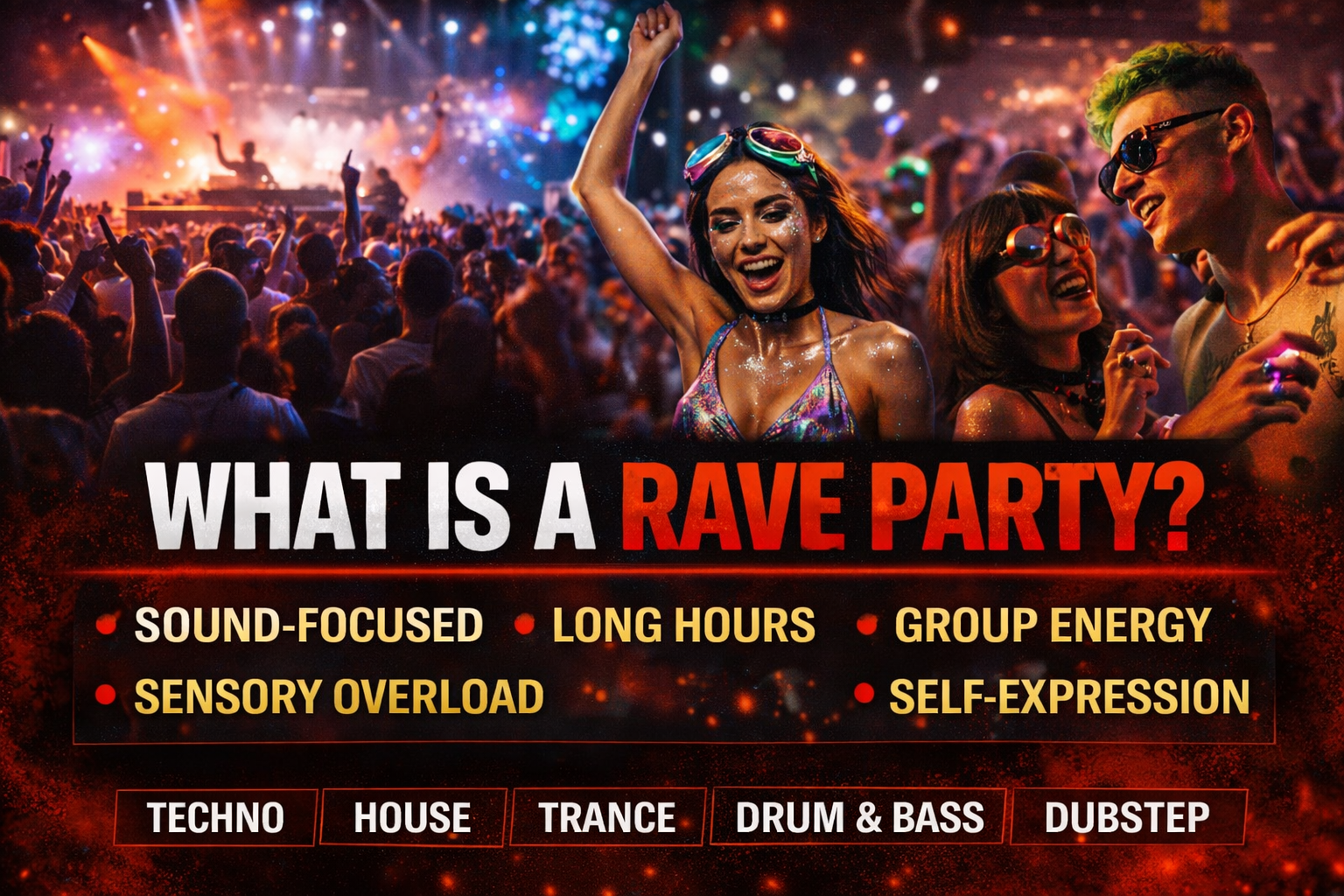
What is a rave party?
A rave party is a high-energy music event centered around electronic dance music (EDM), usually featuring DJs, heavy bass, immersive lighting, and long hours of nonstop dancing. Raves prioritize experience over appearance, community over formality, and sound over spectacle.
If you’re imagining bottle service and dress codes, that’s not a rave — that’s a club pretending.
What is a rave?
A rave is any gathering where electronic music, rhythm, and crowd energy are the main focus. It can be:
- A legal festival
- A warehouse party
- An underground event
- An outdoor pop-up
The defining factor isn’t location — it’s music + movement + collective atmosphere.
What does “rave” mean?
The word rave originally meant to talk wildly or passionately. In modern culture, it refers to events where people lose themselves in music, lights, and motion for hours.
In short: a rave is controlled chaos with a sound system.
What is the meaning of a rave party?
Rave party meaning boils down to this:
- Escapism
- Self-expression
- Community
- Sensory overload
People don’t go to raves to “be seen.” They go to feel something. Anyone telling you it’s about outfits first doesn’t understand the culture.
Is a rave the same as a club party?
No. And anyone who says yes is clueless.
Raves:
- Music-first
- Longer hours
- Minimal rules
- Crowd-focused energy
Clubs:
- Image-first
- Shorter sets
- Dress codes
- Status-driven
A club wants you looking good. A rave wants you moving.
What kind of music is played at rave parties?
Mostly electronic genres, including:
- Techno
- House
- Trance
- Drum & bass
- Dubstep
If lyrics matter more than rhythm, you’re not at a rave.
Do you have to dress a certain way for a rave?
No uniform — but intention matters.
Typical rave fashion prioritizes:
- Comfort
- Breathability
- Freedom of movement
- Personal expression
If your outfit can’t survive sweat, dancing, and hours on your feet, it’s a bad choice. Period.
Are rave parties legal?
Some are. Some aren’t.
- Festivals and licensed events → legal
- Underground warehouse or outdoor raves → sometimes unauthorized
Legality depends on location, permits, and organizers. The culture existed long before permits did — that’s the reality.
Why are rave parties so popular?
Because modern life is rigid, digital, and isolating.
Raves offer:
- Physical release
- Social connection
- A break from algorithms and screens
People aren’t chasing trends. They’re chasing feeling alive.
Is a rave just about partying?
No. That’s a lazy take.
Raves are about:
- Music immersion
- Community energy
- Shared rhythm
Yes, people party — but the core is collective experience, not consumption.